
Derivatives: Problem Solving
복수전공하고 있는 수학과의 졸업시험을 위해 학부 수학 과목들을 다시 공부하고 있습니다. 공부하면서 재밌어 보였던 문제들과 풀이들을 모아서 정리한 포스트 입니다. 미적분학 포스트 전체 보기
모든 점에서 미분 불가능한 연속 함수
연속 함수더라도 몇몇 점에서는 미분이 불가능할 수도 있다. 뾰족점이 있다면 해당 점에서 미분이 불가능하기 때문이다. 그러나 연속 함수에 뾰족점이 없더라도 $f(x) = \sin (1/x)$처럼 무한번 진동하는 함수는 $x=0$에서 미분 불가능이다.
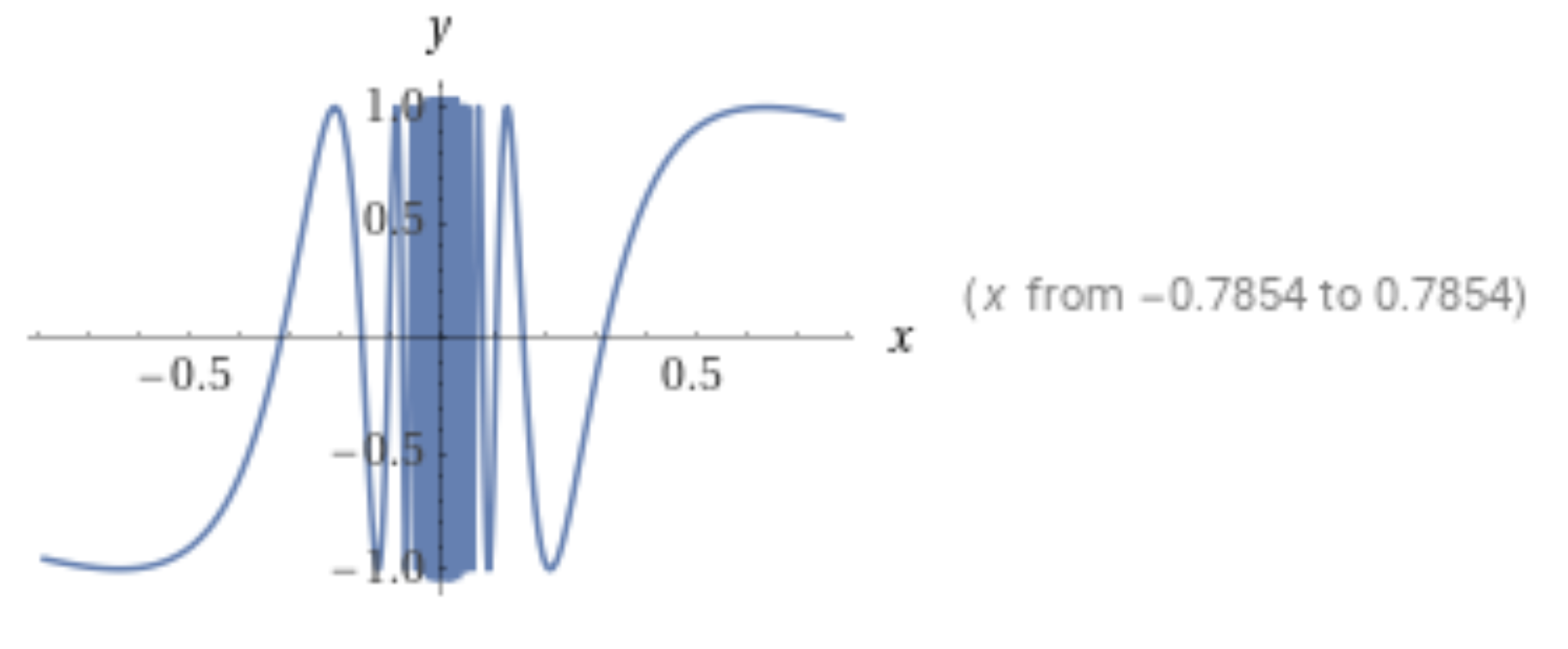
그런데 연속함수인데 특정 위치만 미분 불가능한게 아니라 모든 점에서 미분 불가능한 함수도 있을까?? 이 질문은 전공책 연습 문제에 있던 건데, 연속 함수면 당연히 모든 점에서 미분 가능할 줄 알았던 직관을 깨는 엄청난 명제와 그 예시 였다. 예제는 이런 함수를 소개했다.
Weierstrass’s function.
\[f(x) = \sum_{n=0}^{\infty} a^n \cos (b^n \pi x)\]- $0 < a < 1$
- $b$는 양의 홀수
- $ab > 1 + 3\pi/2$

By Eeyore22 - Own work, Public Domain, Link
함수 모양은 대충 이렇게 생겼다…
요 함수의 연속성과 미분 불가능성에 대해서 증명해야 하는데, 아직 증명을 위해 필요한 파트까지 공부를 못 해서… 일단 증명은 패스 하겠다!!
Generalizing the Product Rule
두 함수의 곱을 미분하면 아래와 같다.
\[\frac{d}{dx} (f(x)g(x)) = f(x)g'(x) + f'(x)g(x)\]만약 함수가 3개, 4개 곱해져 있는 꼴이라면 그것의 미분은 어떻게 될까?? 답은 간단한데, 아래와 같다.
\[\frac{d}{dx} (uvw) = uvw' + uv'w + u'vw\]이렇게 함수 곱에서 하나씩만 미분되고 그걸 모두 합한 꼴이 된다. 증명은 별로 안 어려움~~
About the Chain Rule
Supp. that $f(x) = x^2$ and $g(x) = |x|$. Then the composite
- $(f \circ g)(x) = |x|^2 = x^2$
- $(g \circ f)(x) = |x^2| = x^2$
are both differentiable at $x=0$ even though $g(x)$ itself is not differentiable at $x=0$. Does the contradict the Chain Rule?
결론부터 말하면, Chain Rule과 상충 되지 않는다. 먼저 Chain Rule을 기술하면 아래와 같다.
If $g(x)$ is a function that is differentiable at a point $c$, i.e. the derivative $g’(c)$ exists, and $f(x)$ is a function that is differentiable at $g(c)$, then the composite function $f \circ g$ is differentiable at $c$ …
Chain Rule은 $g’(c)$가 존재하는 상황에서 합성함수가 미분 가능한지를 설명하는 명제다. 이번 경우는 $g’(c=0)$가 미분 불가능하기 때문에 전제가 거짓이다. 따라서 Chain Rule을 적용할 수 없는 상황이다.
어라? Chain Rule을 적용할 수 없다면 합성함수의 도함수를 어떻게 구해야 할까? 만약 그렇다면 도함수의 정의를 바탕으로 합성함수의 도함수를 유도하면 된다. 이번 경우는 $(g \circ f)’(x) = 2x$가 될 것이다.
Chain Rule은 $g’(c)$가 존재할 빠르게 합성함수의 도함수를 구하는 방법일 뿐이다.
The cissoid of Diocles

By HB - Own work, CC BY-SA 4.0, Link
교재 연습 문제 중에 이렇게 생긴 곡선의 접선과 직교선을 구하는 문제가 있었다.
요걸 디오클레스의 시소이드라고 부르며 Implit Function 식은 아래와 같이 나온다.
\[y^2(2-x) = x^3\]일단 이 식이 어떻게 나왔는지를 이해하려면 시소이드(Cissoid)가 뭔지 이해해야 한다.
Cissoid

By Kmhkmh - Own work, CC BY 4.0, Link
좌표계 위에 원점 $O$과 두 곡선(또는 선분) $C_1$, $C_2$가 있는 상황을 생각해보자.
원점 $O$에서 시작해 무한히 뻗어나는 두 곡선 $C_1$, $C_2$을 모두 지나는 선분 $\overrightarrow{OP}$를 잡을 수 있다. 이때 곡선 $C_1$, $C_2$을 지나며 두 곡선 사이의 거리 $\overrightarrow{P_1 P_2}$를 계산할 수 있는데, 그것을 원점 $O$에서 투영한 걸 Cissoid라고 부른다.
식 유도

By Dasha Mic - Own work, CC BY-SA 4.0, Link
일단 원을 $C$, 원에 접하는 선분을 $L$라고 두자. 그리고 원 $C$의 반지름을 $a$라고 두고 $C$와 $L$을 극좌표로 표현 하면 아래와 같다.
\[\begin{aligned} C: r = 2a \cos \theta \\ L: r = 2a \sec \theta \end{aligned}\]Cissoid의 정의에 의해 곡선의 극 방정식은 $L - C$가 된다.
\[r = 2a (\sec \theta - \cos \theta)\]요 식을 조금 변형하면
\[\begin{aligned} r &= 2a \left( \frac{1}{\cos \theta} - \cos \theta \right) \\ &= 2a \frac{1 - \sin^2 \theta}{\cos \theta} \\ &= 2a \sin^2 \theta / \cos \theta \\ &= 2a \sin \theta \tan \theta \end{aligned}\]이제 극 방정식을 직교 좌표계로 변환하면 아래와 같다.
\[\begin{aligned} x &= r \cos \theta = 2a \sin^2 \theta \\ y &= r \sin \theta = 2a \sin^2 \tan \theta \end{aligned}\]이때, $t = \tan \theta$로 두고 parametric equation(매개 방정식)으로 바꿔보면…
\[\sin^2 \theta = \frac{t^2}{1 + t^2}\]이므로
\[\begin{aligned} x &= 2a \sin^2 \theta = \frac{2a t^2}{1 + t^2} \\ y &= 2a \sin^2 \tan \theta = \frac{2a t^3}{1 + t^2} \end{aligned}\]이제 요 식을 정리해보자. $y = xt$이기 때문에 $t = y/x$로 두고 식을 정리하면 된다.
\[\begin{aligned} x &= \frac{2a y^2 / x^2}{1 + y^2 / x^2} \\ &= \frac{2a y^2}{ x^2 + y^2} \end{aligned}\]최종적으로 아래의 식이 도출 된다.
\[x(x^2 + y^2) = 2ay^2\]$\blacksquare$
Applications
Making Coffee
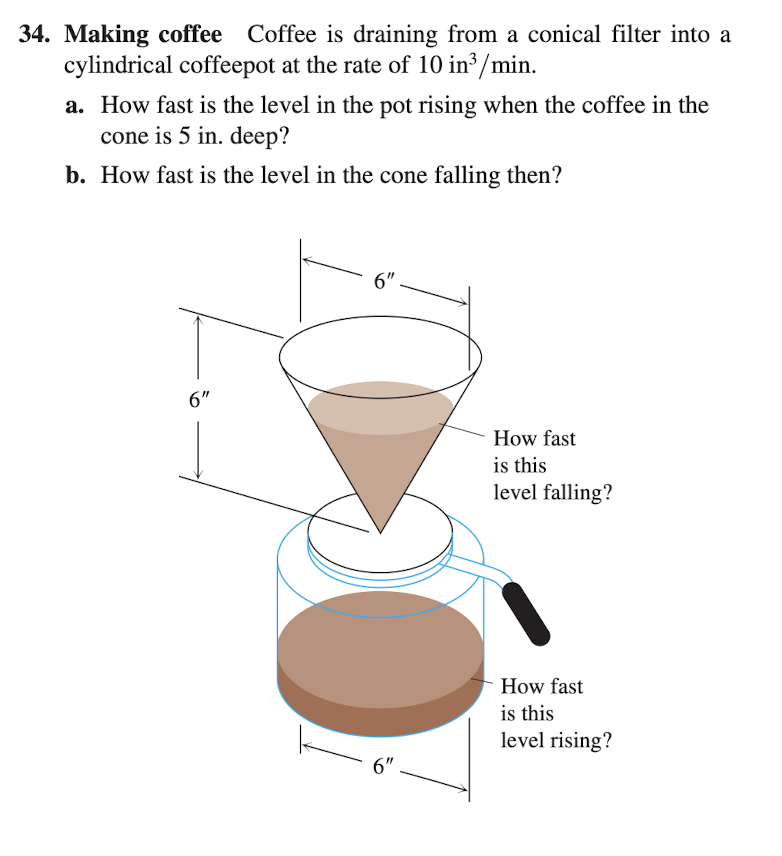 Thomas Calculus 13th ed. - Example Problem
원뿔과 원기둥의 높이 변화에 대한 식을 유도하는 문제다. 뭔가 드립 커피 내려먹을 때 생각날 것 같은 문제라서 풀어봤다 ㅋㅋ
일단 원뿔과 원기둥에 대해 아래 식이 성립한다.
\[V_1(t) + V_2(t) = \text{const.}\]그리고 초기 $t=0$ 때 원뿔에 커피가 가득 차 있었다면, 그 부피는
\[V_1(t=0) = \pi r^2 \cdot 1/3 \cdot h = 18 \pi\]그리고 부피가 $10 t$ 만큼 줄어든다고 했으니 부피에 대한 식은 이렇게 될 것이다.
\[\begin{aligned} V_1(t) &= 18 \pi - 10 t \\ V_2(t) &= 10 t \end{aligned}\]이제 위의 두 식을 높이 $h_1(t)$, $h_2(t)$에 대한 식으로 바꿔보자.
원기둥은 아래에서 위로 높이가 증가하기 때문에 더 구하기 쉬우니 먼저 구하자.
\[\begin{aligned} V_2(t) &= 10 t = 3^2 \pi \cdot h_2(t) \\ h_2(t) &= \frac{10 t}{9 \pi} \end{aligned}\]이제 원뿔에 대해서 구해보자. 원뿔의 높이 $h_1(t)$는 시간이 지날 수록 감소한다. 게다가 원뿔의 밑면의 반지름도 시간이 지날 수록 감소한다. 다행히 원뿔에서 높이와 반지름이 2:1 비율이니 밑면의 반지름은 $h_1(t)/2$가 되긴 할거다.
\[V_1(t) = 18 \pi - 10 t = (h_1(t)/2)^2 \pi \cdot 1/3 \cdot h_1(t) = \frac{\pi \cdot (h_1(t))^3}{12}\]이때, 원기둥과 원뿔의 높이의 변화율을 확인해보자.
먼저 원기둥의 높이 변화율의 값은 일정하다.
\[h_2'(t) = \frac{10}{9\pi}\]원뿔의 높이 변화율은 원뿔 높이의 제곱에 반비례 한다.
\[\begin{aligned} V_1'(t) = - 10 &= \frac{\pi}{12} \cdot 3 (h_1(t))^2 h_1'(t) \\ h_1'(t) &\propto - 1 / h_1(t)^2 \end{aligned}\]즉, 원뿔의 높이가 높을 때는 천천히 감소하다가 원뿔의 높이가 낮을 때는 높이가 빠르게 감소한다. $\blacksquare$
사실 $h_1(t)$에 대한 식을 Implicit Function 형태가 아니라 $t$에 대한 정확한 식으로 표현할 수 있었지만, 그렇게 하지 않고 Implicit Function에서 형태에서 바로 미분한게 오히려 높이의 변화율을 아는데 더 도움이 된 것 같다.
exponential function defined by limit
Show that
\[\lim_{n\rightarrow \infty} \left( 1 + \frac{x}{n} \right)^n = e^x\]for any $x > 0$.
$1^{\infty}$ 꼴의 부정형이다! 이 경우 $\ln$을 씌우고, 거기에 로피탈 정리를 적용하는 접근을 “교재에서” 언급 했다.
Let $f(n) = \left( 1 + \frac{x}{n} \right)^n$, we will see $\lim \ln f(n)$.
\[\begin{aligned} \lim_{n\rightarrow \infty} \ln f(n) &= \lim n \cdot \ln (1 + x/n) \\ &= \lim \frac{\ln(1+x/n)}{1/n} \end{aligned}\]요렇게 두면 $0 / 0$ 꼴의 부정형이기 때문에 로피탈 정리를 적용해 극한을 구할 수 있다!
\[\lim \frac{\ln(1+x/n)}{1/n} \rightarrow \lim \frac{\frac{1}{1+x/n} \cdot - \frac{x}{n^2}}{- 1 / n^2} = \lim \frac{n x}{n + x} = \lim \ln f(n)\]이제 $\ln$을 씌웠던 걸 다시 풀어보면
\[\begin{aligned} \lim_{n \rightarrow \infty} f(n) &= \lim_{n \rightarrow \infty} e^{\ln f(n)} \\ &= \lim_{n \rightarrow \infty} e^{\frac{nx}{n+x}} \\ &= \lim_{n \rightarrow \infty} e^{x \cdot \frac{n}{n+x}} \\ \end{aligned}\]이때 $\frac{n}{n+x}$의 극한은 $1$로 수렴하므로, 최종적으로 $e^x$만 남게 된다. $\blacksquare$
Newton’s Serpentine
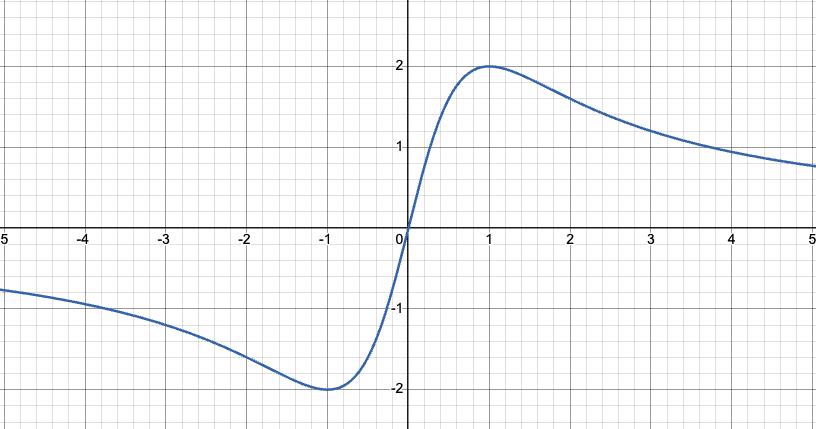
Newton이 정형화한 Cubic Curve. 아래와 같은 방정식을 갖는다.
\[y(x^2 + a^2) = abx\]몇가지 특정을 가지고 있는데
- 원점을 중심으로 반전.
- $x$축이 점근선
- 함수값은 $y = \pm b / 2$ 사이에 존재
Parametric Equation
Serpentine Curve를 parametric equation으로 표현하면 아래와 같다.
\[\begin{aligned} x &= a \tan t \\ y &= b \sin t \cos t \end{aligned}\]이때 식을 조금 변형하고 정리하면 Explicit Form으로 표현할 수도 있다!!
\[\begin{aligned} \arctan x/a &= t \\ y = b \sin t \cos t &= b \sin (2t) \\ \end{aligned}\]따라서 $y = b \sin (2 \cdot \arctan x / a)$의 형태로 정리된다. 그래프를 그려보면 Implicit Form으로 적은 것과 동일한 것도 확인할 수 있다 ㅎㅎ
참고문헌
- Wikipedia